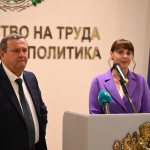
Minister Efremova: Social workers visited more than 400 affected families in the first days following the flooding

After the floods that affected the country over the weekend, social workers visited more than 400 affected homes in 10 settlements. From the very first hours of the disaster, they were on the ground-initially volunteering to assist families whose homes had been flooded, and subsequently carrying out their core responsibilities of assessing damage and providing consultations. This was stated by the Minister of Labour and Social Policy, Natalia Efremova, during a press conference presenting the leadership team and priorities of the Ministry of Labour and Social Policy (MLSP).
Minister Efremova emphasized that she personally visited the areas most severely affected by the flooding in Sevlievo and the surrounding settlements in order to coordinate, on site, the actions of the local authorities and social services. She expressed her condolences to the family of the person who lost their life after being swept away by the waters of the Rositsa River.
According to data from the Social Assistance Agency (SAA), 179 households have so far been visited in Sevlievo alone, with a total of 41 applications for assistance having been submitted. In Dryanovo, 50 families have been visited; in Veliko Tarnovo, 38; and in Gabrovo, 22. Social workers have also visited 22 homes in Gorna Oryahovitsa, 48 in Apriltsi, 12 in Troyan, and 7 affected households in Lovech.
Minister Efremova emphasized that state support is aimed at meeting the most urgent needs of people left without access to medicines, clothing, and basic living conditions. “I categorically do not wish to accept, and I disagree with, claims that the support is insufficient, not properly targeted, or that some people are unable to benefit from it,” the Minister stated.
She recalled that affected individuals may receive three forms of support-two through the Social Assistance Agency and one through the Social Protection Fund under the Ministry of Labour and Social Policy. The first type of assistance is intended to address urgent and unforeseen essential needs and amounts to up to three times the poverty line, i.e. up to EUR 1,171. After receiving this support, households may also apply for assistance of EUR 1,300 for the replacement of destroyed household appliances. In addition, affected individuals may receive up to EUR 1,550 in supplementary assistance for the repair of damages. Social assistance is granted when the affected property is the household’s primary residence and has been legally constructed.
Minister Efremova stressed that applications for assistance are submitted through a simplified procedure at the local Social Assistance Directorates, while the verification process and payment of funds are carried out within short time frames. She called on affected citizens to apply for assistance and urged mayors to work in close coordination with social services to ensure maximum support for impacted households.
Minister Efremova also presented the Government’s priorities in the fields of labour and social policy. These include the preparation of the 2026 state budget, ensuring the sustainability of the pension system, strengthening efforts to combat the shadow economy, and improving the effectiveness of investments in workforce training and skills development.
She identified the preparation of the 2026 budget as the most urgent task, in order to guarantee that all social benefits are paid on time and that pensions will be increased by 7.8% as of 1 July.
The sustainability of the pension system will also remain a key focus of the Ministry’s work. The Minister announced that efforts will be directed towards improving the collection of social security contributions and reducing the shadow economy through enhanced institutional oversight.
Minister Efremova also highlighted labour market policies, training programmes, and workforce upskilling as priority areas. She identified demographic policy as a fundamental issue for the country and stated that the Ministry of Labour and Social Policy will continue to expand support under the “I Choose Bulgaria” initiative, which aims to attract Bulgarians living abroad to return to Bulgaria for work and residence. The support is financed under the Human Resources Development Programme.